On 8 September, the Spanish State Research Agency (AEI) published the final award decision for the 2025 Torres Quevedo programme. Two days later, it proposed funding two additional applications from the reserve list. This brings to a close, for all practical purposes, a call that opened on 29 October 2025.
And the timing is useful: the 2026 call opens on 8 October and closes on 29 October.
As I previously did with Innterconecta-STEP, I reviewed all the documents published by the AEI throughout the procedure —requests for additional information, exclusions, provisional and final proposals, and the final award decision— to identify the information that is most useful for companies considering an application: what funded projects look like, which types of organisations succeed, how long the process takes and, above all, why some applications ultimately fall out of the process.
The award in numbers
The final decision awards 199 Torres Quevedo contracts to 166 organisations, for a total of €19,003,852 distributed over three annual instalments (2027, 2028 and 2029).
If the two reserve-list applications proposed on 10 September are confirmed, the total will rise to 201 contracts and €19.23 million, meaning that approximately 96% of the call’s €20.1 million budget will have been allocated.
| Indicator | Value |
|---|---|
| Contracts awarded | 199 (+2 proposed from the reserve list) |
| Beneficiary organisations | 166 |
| Total grant funding (3 years) | €19.0m |
| Average employment cost per contract | €54,676 / year |
| Average grant per contract | €31,832 / year · €95,497 over 3 years |
| Weighted average aid intensity | 58% |
| Contracts receiving the maximum 70% intensity | 102 (51%) |
The headline picture is straightforward: the typical funded case is a small enterprise hiring a PhD holder to work on an industrial research project, with an annual employment cost of around €55,000 and annual grant funding of approximately €32,000.
Half of all awarded contracts receive the maximum 70% funding intensity, which is available only to small enterprises carrying out industrial research.
Who receives the funding?
In practice, Torres Quevedo is a programme strongly dominated by small enterprises. Four out of every five awarded contracts go to small companies, which account for an even larger share of the total funding because they benefit from higher aid intensities.
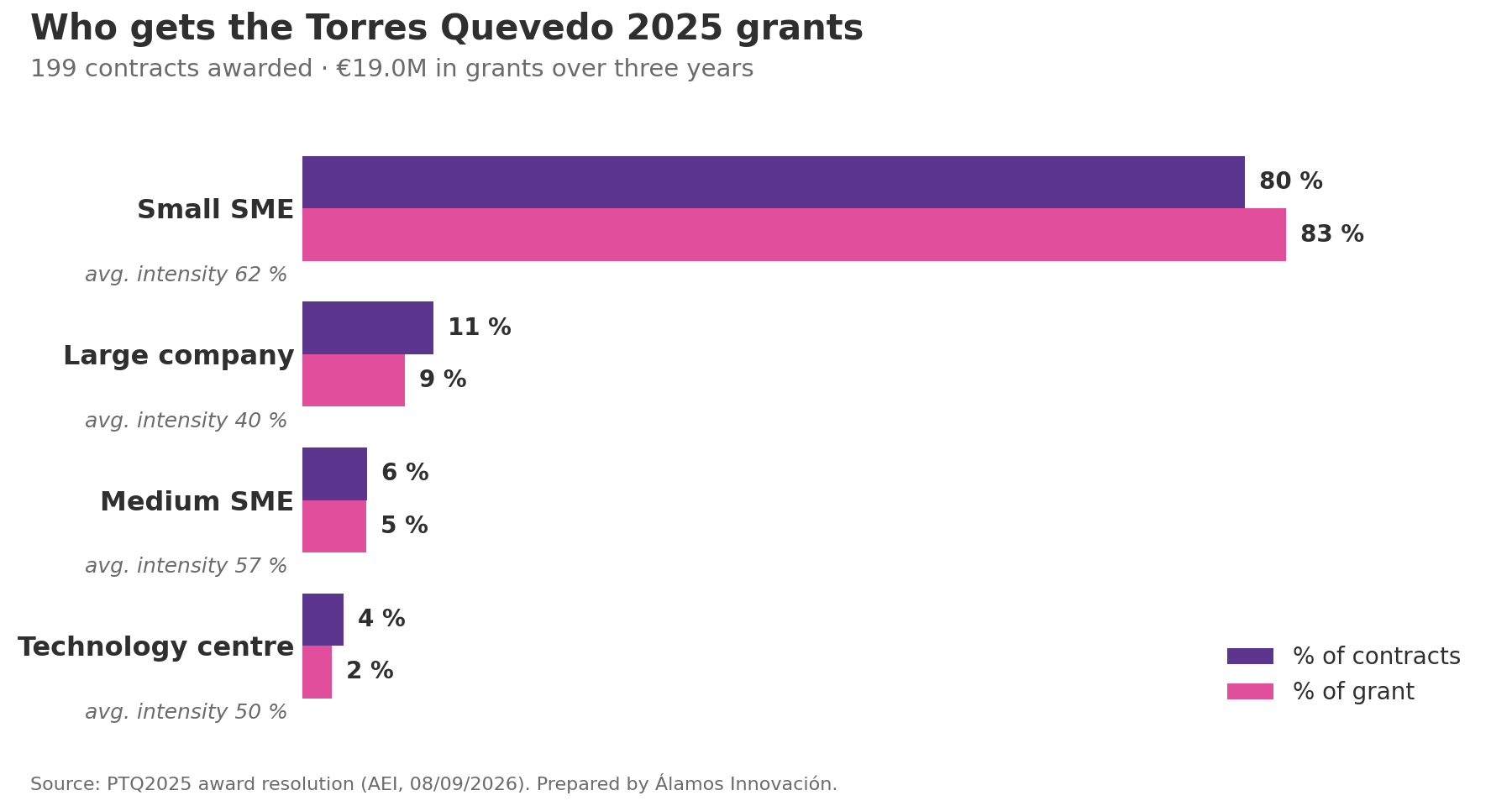
Of the 199 contracts, 159 go to small enterprises (€15.85m), 22 to large companies (€1.66m), 11 to medium-sized enterprises (€1.02m) and 7 to technology centres (€0.47m).
Large companies are by no means excluded, but they receive significantly lower funding intensities —40% on average— and an average grant of around €75,000 per contract over three years, compared with almost €100,000 for a small enterprise. Technology centres account for only seven contracts, funded at an intensity of 50%.
The picture is equally clear when looking at project type. Industrial research overwhelmingly dominates the programme: 165 contracts (83%), compared with 25 experimental development projects (13%) and 9 feasibility studies (4%).
This is unlikely to be a coincidence. Maximum funding intensities for industrial research —70%, 60% and 50% depending on company size— are substantially higher than those for experimental development —45%, 35% and 25%.
The difference is also visible in the weighted average funding rate: 61% for industrial research compared with 37% for experimental development.
Where the technical content genuinely supports it, therefore, framing a project as industrial research can make a substantial difference to the level of funding available.
Another interesting figure shows how some of the most active companies use the programme: 25 organisations obtain two or three contracts in the same call, including eight that receive three.
Biotech and pharmaceutical companies feature prominently among those receiving three contracts, alongside scientific consulting and software companies.
Torres Quevedo allows organisations to submit more than one application, provided that the projects are clearly distinct. Some companies use this possibility to make a significant addition to their R&D teams through a single call.
From the provisional proposal to the final award: what happens between May and September
The provisional award proposal published on 13 May selected 211 applications and placed another 25 on the reserve list.
The final award includes 199 contracts, together with the two reserve-list applications subsequently proposed for funding.
In other words, 30 applications initially selected in May did not make it through to the final award, and their places were taken by applications from the reserve list.
This leads to one of the most striking figures in the entire process: 20 of the 25 applications placed on the reserve list ultimately received funding.
Being placed on the reserve list in Torres Quevedo therefore does not necessarily mean rejection. In the 2025 call, four out of five reserve-list applications eventually received funding, albeit several months later. The reason is the number of withdrawals and discontinued applications between the provisional proposal and the final award.
Why applications drop out
During the procedure, the AEI published three decisions covering excluded or discontinued applications, affecting a total of 47 cases. Grouping the reasons reveals several useful lessons.
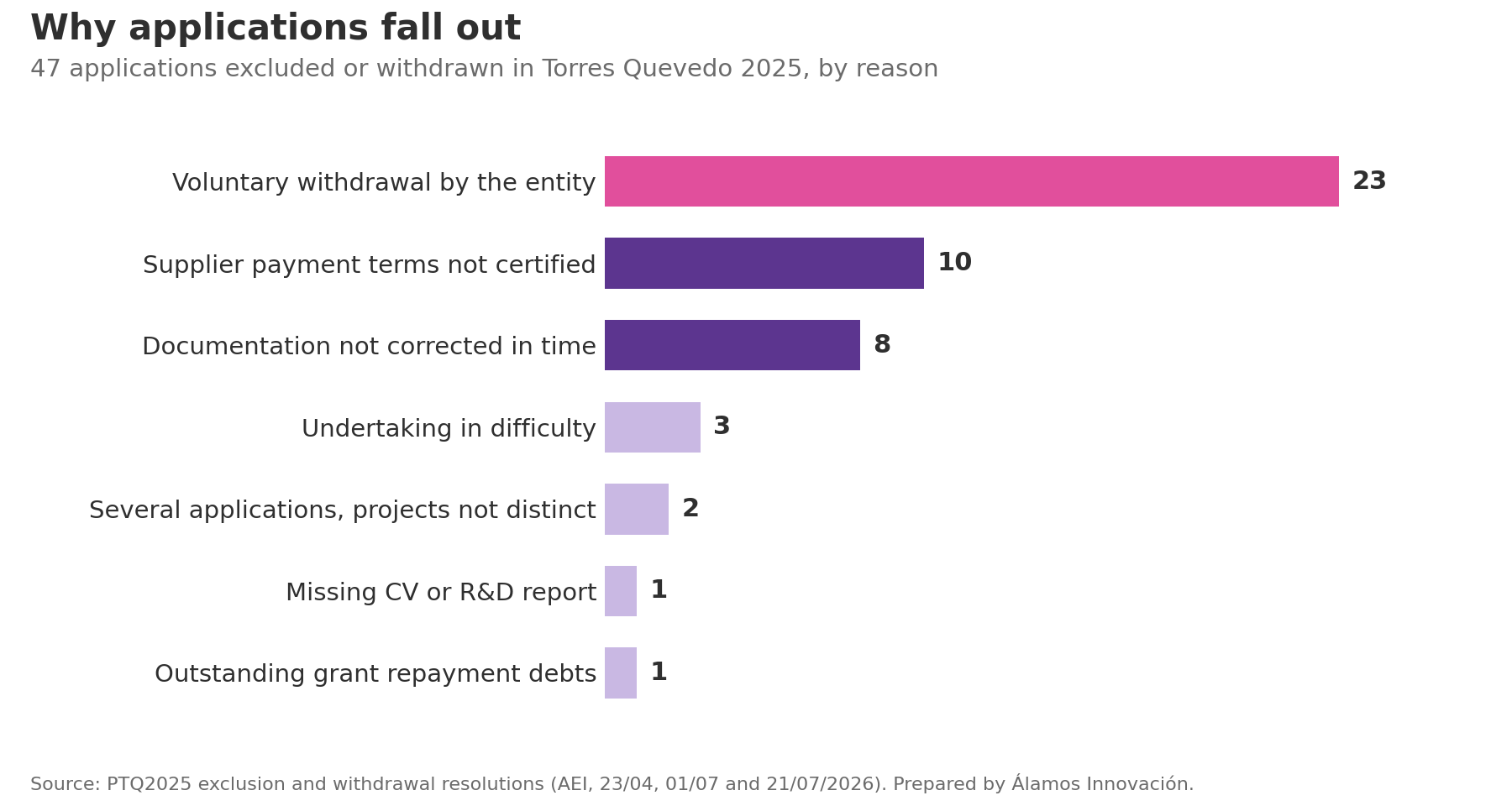
Three stand out in particular.
The leading cause of applications falling out is not technical evaluation, but withdrawal or discontinuation by the applicant itself.
Almost half of the applications that leave the process do so for this reason, and many of these withdrawals occur after publication of the provisional award proposal —in other words, when the funding is already close to being secured.
The underlying reason may be that the candidate is no longer available, the company’s priorities have changed or the proposed employment contract no longer makes sense by the time it needs to be signed.
Submitting an application without having a reasonably firm commitment from the PhD candidate, or without having internally confirmed that the company will actually proceed with the hire if funding is awarded, creates a significant risk of losing a grant that has already been effectively won.
The second major cause is purely administrative and, to a large extent, preventable.
Ten applications dropped out because they failed to provide evidence of compliance with the supplier payment periods required under Article 13.3 bis of Spain’s General Subsidies Act for grants above €30,000.
This evidence must be provided within ten working days of the provisional award proposal: through a self-declaration where the company is eligible to file an abridged profit and loss account, or through an auditor’s certificate —or an agreed-upon procedures report— where it is not.
A company that reaches May without knowing which route applies to it and, where necessary, without having identified an auditor who can issue the required documentation runs a genuine risk of losing the grant over an administrative requirement.
The third issue is the “undertaking in difficulty” condition.
In its March request for additional information, the AEI flagged 11 applications because the companies concerned might qualify as undertakings in difficulty. Three were formally excluded and another five failed to respond to the request and were therefore treated as having withdrawn.
This is a condition worth checking before the application is submitted —including the relationship between equity and share capital, insolvency proceedings and any outstanding rescue aid— because if the company fails this eligibility requirement, the quality of the project cannot compensate for it.
The same request for additional information also highlights some of the most common formal deficiencies.
The most frequent is surprisingly basic: 14 applications had to provide evidence of the PhD qualification including the exact date on which the thesis was defended.
Other issues included CVs that did not correspond to the proposed candidate, previous employment relationships between the candidate and the applicant during the exclusion period, and questions over whether the candidate exercised control over the company’s share capital.
All of these issues can potentially be corrected, but all can also be avoided through a proper documentary review before submission.
A final point concerns multiple applications. The AEI raised concerns in six applications submitted by several organisations because the proposed projects were not sufficiently distinct from one another.
Two were ultimately excluded. Three of the remaining applicants successfully demonstrated during the hearing stage that each project had its own substantive identity and ultimately received funding.
The takeaway is simple: if a company submits several applications, each project must stand on its own, with a distinct technical rationale and its own proposal.
How long does the process take?
Companies planning the recruitment of a PhD holder need to understand the real timetable.
The 2025 call closed on 18 December 2025. From that date, the provisional award proposal took approximately five months —until 13 May—; the final proposal took six and a half months —until 1 July—; and the final award decision took almost nine months —until 8 September.
Adding the twenty working days available to formalise the employment contracts means that the researcher joins the company around nine to ten months after the application is submitted, in this case in October 2026.
That is a long period to manage with a candidate, who may find it difficult to remain available for so many months unless there is a clear commitment on both sides.
There are also two points in the procedure that require a rapid response.
The first is the request for additional information, issued around three months into the process with ten working days to respond. The second is the provisional award proposal, around five months after submission, which opens another ten-working-day period to accept the funding and provide evidence of compliance with supplier payment periods.
What does this mean for the 2026 call?
The 2026 call opens on 8 October and closes on 29 October. Based on the 2025 results, these are the issues I would recommend having resolved before submitting an application:
- A confirmed candidate and complete documentation. The PhD holder should already be committed to the project, with evidence of the qualification and exact thesis defence date available, no previous employment relationship with the applicant or linked companies during the exclusion period, and no controlling interest in the company’s capital.
- The undertaking-in-difficulty test completed using the latest available accounts, with annual accounts properly filed and up to date at the Commercial Registry.
- Supplier-payment compliance prepared in advance. The company should know whether it can rely on a self-declaration or needs an auditor’s certificate and, in the latter case, should already know which auditor can provide it within the ten-working-day deadline.
- The project classified as industrial research where the technical content genuinely supports that classification. Industrial research accounts for 83% of funded contracts and offers the highest aid intensities.
- Clearly differentiated projects where several applications are submitted. Each should have its own proposal, objectives and technical rationale.
- An internal commitment to proceed with the hire once funding is awarded. The 2025 results show that late withdrawals are one of the main reasons why funding that has effectively already been secured is ultimately lost.
How I can help
For calls under Spain’s State Research Plan, I work in collaboration with Soros Gabinete, a technical consultancy specialising in the management of R&D and innovation projects, where I collaborate as an external consultant.
Together, we support companies and technology centres throughout the process: assessing the fit of the project and candidate, preparing the technical proposal, managing the administrative documentation —including supplier-payment compliance and the undertaking-in-difficulty assessment— and providing follow-up support once the grant has been awarded.
If you are considering an application to Torres Quevedo 2026 and would like to review your project’s fit in good time before 8 October, you can contact me at contacto@alamosinnovacion.com.
Note: all figures in this article have been calculated from the official documents published by the AEI for the 2025 Torres Quevedo call: request for financial documentation (27/01/2026), requests for additional information (13 and 17/03/2026), decisions on exclusions and discontinued applications (23/04, 01/07 and 21/07/2026), provisional award proposal (13/05/2026), final proposal (01/07/2026), final award decision (08/09/2026) and proposal to award funding to reserve-list applications (10/09/2026). The AEI does not publish the total number of applications submitted in these documents, so the ratios in this article refer to the 236 applications that reached the provisional award stage. The call budget (€20.1m) and the dates of the 2026 call are taken from official AEI information referenced in my previous article on Industrial Doctorates and Torres Quevedo 2026.