
On 14 September, Spain's Ministry of Science, Innovation and Universities announced a €100 million increase for the 2026 NEOTEC and Misiones Ciencia e Innovación calls. For NEOTEC, the budget goes from the initial €20 million to €40 million, with the additional €20 million earmarked for technology-based companies developing dual-use technologies, that is, with both civil and security or defence applications.
The news matters for what it says between the lines. The Ministry itself acknowledges that, typically, only 15 % to 25 % of the proposals submitted to NEOTEC receive funding, and that every year many proposals scoring above 70 points are left without support for budgetary reasons. With twice the budget, and with the dual-use strand absorbing part of the demand, the 2026 call will be able to fund considerably more projects than planned, civil ones included.
I have supported several companies through their NEOTEC proposals and the subsequent justification of the grant, which lets me see the programme from two different moments: the business plan that is submitted, and what the company looks like one or two years later. In this article I want to explain what NEOTEC offers, what kind of projects it is funding according to the 2024 and 2025 award decisions, and what I have seen in practice, without naming names, in companies that have gone through it.
What NEOTEC is and what exactly it offers
NEOTEC is CDTI's programme for the creation and consolidation of early-stage technology-based companies. It does not fund a standalone R&D project, but the business plan of a company whose competitive advantage is the technology it develops. CDTI says so explicitly: business models based mainly on services to third parties without proprietary technology development do not fit.
The conditions of the 2026 call, which closed on 14 May, sum up well what the programme puts on the table:
| Condition | NEOTEC 2026 |
|---|---|
| Who can apply | Innovative small companies up to 3 years old with a minimum share capital of €20,000 |
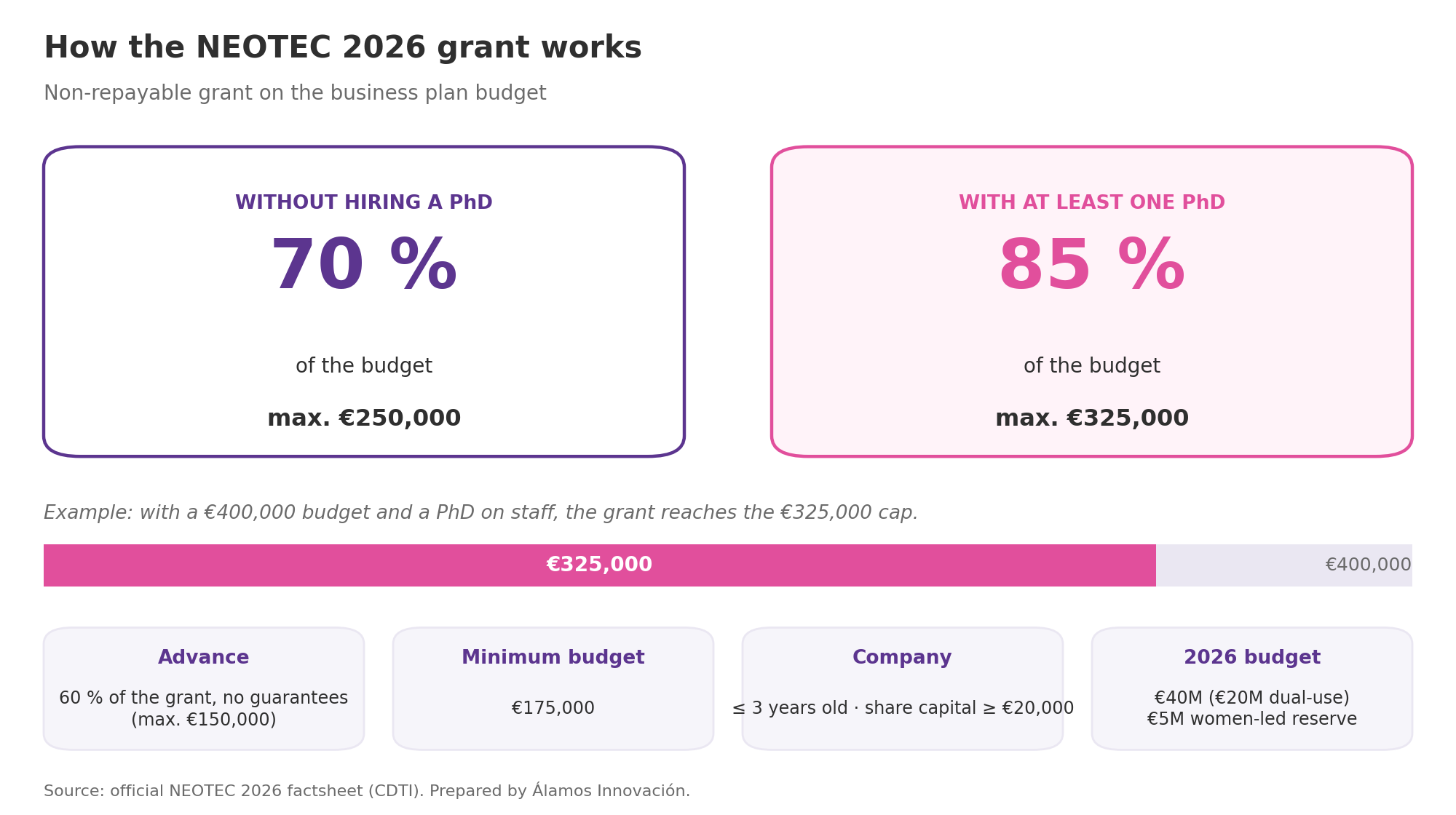
| Grant | Non-repayable grant of up to 70 % of the budget, capped at €250,000 |
| If at least one PhD is hired | Up to 85 % of the budget, capped at €325,000 |
| Minimum project budget | €175,000 |
| Advance payment | Up to 60 % of the grant (max. €150,000) with no guarantees |
| Reserve for women-led companies | €5 million |
| Training extra | Course at MIT (up to €18,300) or GeorgiaTech (up to €10,000) |
| Eligible costs | Staff, assets, materials, external collaborations (subcontracting up to 50 %), rent, patents, promotion, training |
Three details make the difference compared with other schemes. The first is that it is a non-repayable grant, not a loan: for a company with little or no revenue yet, that completely changes how the balance sheet reads. The second is the 60 % advance with no collateral, which solves the cash-flow problem a startup usually has to execute the project. And the third is the PhD incentive: hiring someone with a doctorate raises the intensity to 85 % and the cap to €325,000, which in practice makes the PhD a hire almost entirely financed by the programme.
What kind of projects NEOTEC is funding
More than the figures, what interests me is what the 2024 and 2025 award decisions say about the profile of project that gets through.
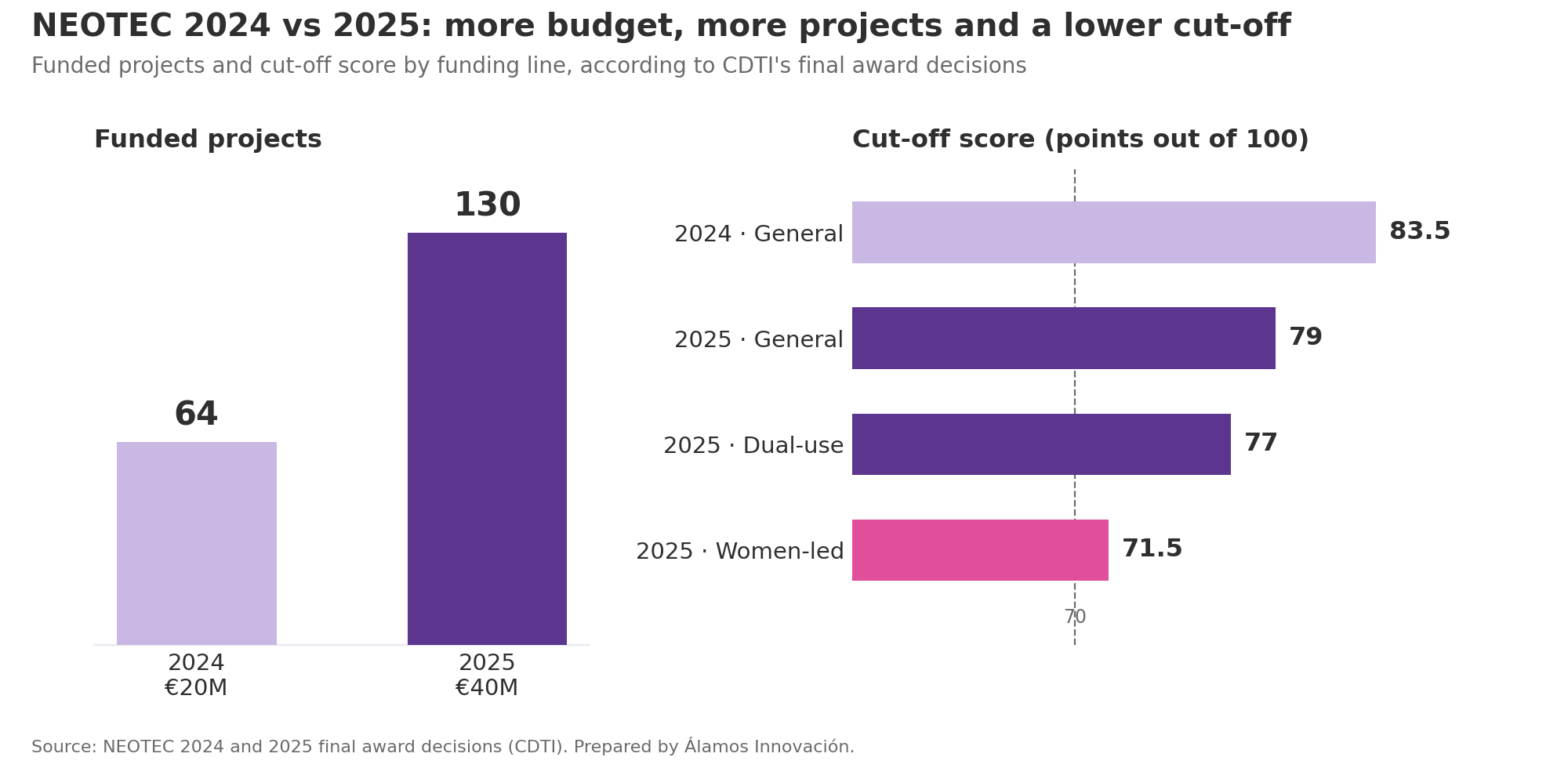
In 2024, with a €20 million budget, 64 projects were funded out of more than 400 applications: around 15 %. The cut-off score in the general funding line was 83.5 points, and more than a hundred proposals with 70 points or more were left out for budgetary reasons. In 2025, now with €40 million (20 general, 20 dual-use and a €5 million reserve for women-led companies), 130 projects were funded and the cut-off dropped to 79 points in the general line, 77 in the dual-use line and 71.5 in the women-led reserve. As for size, eight out of ten funded projects have budgets between €350,000 and €450,000, with a median close to €390,000. That is no coincidence: reaching the €325,000 grant cap at 85 % intensity requires a budget of at least €382,000, and that cap ends up setting the size of the projects.
One figure sums up very well how competition works in NEOTEC: in 2025, seven out of ten funded projects reached the €325,000 cap, which means they included hiring a PhD. It is not a requirement, but the programme rewards it with higher intensity and a higher amount, and most of the companies that succeed know it.
As for sectors, the list of funded projects is deliberately cross-cutting, because NEOTEC has no thematic priorities. But clear patterns do emerge:
- Health, biotechnology and medical technology is the most recognisable block: new therapies, diagnostic devices, medical imaging with artificial intelligence, drug discovery platforms.
- Artificial intelligence and software with proprietary technology: models and algorithms developed by the company for a specific problem (optimisation, computer vision, digital twins, agents). The key is not "using AI", but AI being the company's technological asset.
- Hardware, photonics, sensors and robotics: chips, optical systems, robots for industrial or agricultural environments, instrumentation.
- Energy and clean technologies: storage, hydrogen, wind, waste bioconversion.
- And since 2025, a very recognisable dual-use block: cybersecurity, sensing and detection, autonomous navigation, communications, space and infrastructure security.
What the successful projects have in common is not the sector, but that in all of them the technology is the product. When the business plan describes a service built on third-party tools, the proposal does not fit, however good the business may be.
What I have seen in companies that have gone through NEOTEC
I would rather not talk about specific cases, but about what repeats itself. When I compare the business plan that is submitted with the justification delivered one or two years later, there are patterns that appear almost every time.
The entry profile is usually incomplete on one of two sides. Some companies arrive with a product and commercial traction —customers, revenue, even an acceleration programme behind them— but with technology that is not yet differentiating: they solve a problem with known tools. And there are spin-offs that arrive with solid, protected, scientifically validated technology but very little market. NEOTEC serves to close the gap in both directions, provided the business plan explains clearly what that gap is and how it will be closed.
What the grant provides is R&D time that would not otherwise exist. The most visible effect is that the company can devote a year or two to serious technological development —a proprietary engine, a scalable platform, a validated methodology, an integration layer with its customers' systems— without ceasing to operate the business it already had. And that development almost always goes hand in hand with the technical hires the plan envisaged, with the PhD as the central piece: the person who builds the core of the technology and, on top of that, raises the grant to 85 %.
NEOTEC becomes the anchor of the company's financing. The award is read externally as validation. From there it is common to see bank advances on the grant itself, participative loans from ENISA, convertible notes from the initial investors and, once the product is validated, a first funding round. The programme does not replace private investment, but very often it is what makes it possible.
What NEOTEC does not do is sell. This is the least comfortable part to tell. Sales at companies that have gone through the programme usually grow, but below what the plan envisaged, and cash remains tight throughout execution: the advance helps, but the rest of the grant arrives upon justification. A company that comes out of NEOTEC with much better technology and modest sales has not failed, but it needs to have planned from the outset how it will turn that technology into customers, because the business plan is evaluated —and later justified— on that too.
The justification is the test of the plan. CDTI does not only review expenses: it asks the company to explain what has been achieved against what was promised, how the team has evolved, what sales have been generated and how the financing has been completed. Well-built plans, with realistic objectives and an executable budget, are justified naturally; those written to score points are not.
What to be clear about before applying
The 2026 call is closed and in the resolution phase (CDTI has already asked applicants for information on the dual-use nature of their projects in order to apply the budget increase). The next window will foreseeably be spring 2027, with projects starting in January 2028. Based on the latest award decisions and the cases above, this is what I would recommend having resolved beforehand:
- Proprietary technology at the core of the business. This is the criterion that leaves the most proposals out. If the plan describes a service built on third-party tools, it does not fit; if it describes a proprietary technological development with a business model behind it, it does.
- A business plan, not a technical report. NEOTEC assesses market, business model, team and impact as much as technology. The plans that work explain with equal solidity what will be developed and who it will be sold to.
- Hiring a PhD. It raises the intensity to 85 % and the cap to €325,000, and in 2025 seven out of ten funded projects included it. It is worth having the profile identified, not just the intention.
- A realistic, executable budget. Minimum €175,000, and in practice between €350,000 and €450,000 in most funded projects, with technical staff as the main item.
- A cash plan. The 60 % advance helps a lot, but the remaining 40 % arrives upon justification. The companies that manage it best combine NEOTEC with ENISA, bank advances on the grant or a funding round.
- Women-led companies and dual-use projects. Both have their own budget reserve and, in 2025, a lower cut-off score than the general line: 77 points in the dual-use line and 71.5 in the women-led reserve, versus 79 in the general line. If the project fits either, make it explicit.
- Target score above 80. With €40 million, the 2025 cut-off dropped to 77-79 points; with €20 million, the 2024 cut-off was 83.5. The 2026 increase helps, but a proposal aiming to get in comfortably should be built to exceed 80 points.
If I can help
NEOTEC is one of the calls I have worked on most, both at proposal stage and in the subsequent justification, which is where you really see whether the business plan was well built. If you have a technology-based company less than three years old and are thinking of applying in 2027, this is a good time to review the fit calmly: the technology, the team, the budget and, above all, the business plan behind it.
Write to me at contacto@alamosinnovacion.com and we can take a look.
Note: the call conditions come from CDTI's official NEOTEC 2026 factsheet and the Ministry's announcement of 14 September 2026. The figures on funded projects, cut-off scores and applications are calculated from the final award decisions of NEOTEC 2024 (including the subsequent partial decision) and NEOTEC 2025 published by CDTI. The observations about companies come from real NEOTEC projects I have worked on, both at proposal and at justification stage; names and any identifying details have been omitted.