
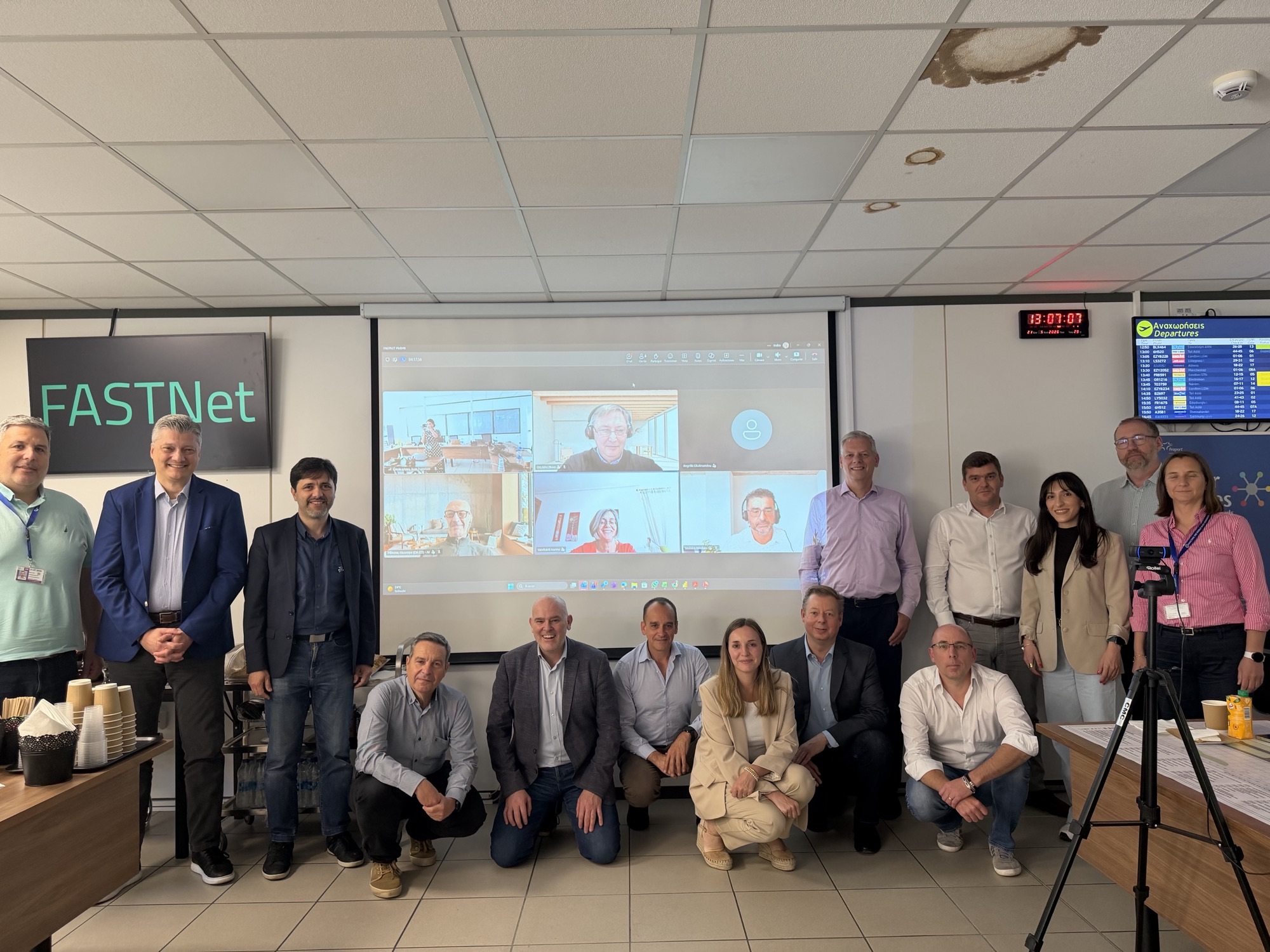
Last week, the SESAR FASTNET project held its final Project Management Board meeting in Rhodes, closing an important chapter of a project that has brought together airports, airlines, industry, EUROCONTROL and operational experts around a shared goal: improving the integration of airport operations into the European air traffic management network.
FASTNET — Future Data Services and Applications for Airports and Network — is a Fast Track project of the SESAR 3 Joint Undertaking, co-funded by the European Union under the Digital European Sky programme. The consortium has been led by INDRA, coordinating the work of a group of European partners to explore how better data exchange, artificial intelligence and collaborative planning can contribute to more predictable, efficient and connected airport and network operations.
For me, this final meeting has been much more than a project milestone. It has also marked the closing of a journey in which I have had the opportunity to support the consortium through Soros Gabinete, contracted by INDRA to assist with the project coordination: reporting follow-up, financial management, meeting preparation, administrative processes and the day-to-day organisation that a European project of this complexity requires to move forward.
Working on FASTNET has been a very valuable experience. European research projects are not only technical deliverables; they are people, trust, coordination and perseverance. Behind every deliverable, review, meeting and deadline there is a great deal of work that often goes unseen, but is essential to the project's success.
Over these three years, I have seen how partners from very different organisations have worked together to address operational challenges that are relevant for the future of European aviation. FASTNET has focused on two SESAR solutions: one aimed at improving tactical AOP–NOP planning, including direct airport-to-airport coordination and taxi-time prediction; and another focused on enriching AOP–NOP data in the strategic and pre-tactical phases, using more complete information and predictive models to improve planning ahead of the day of operations.
The final meeting in Rhodes allowed us to review the project's achievements, the conclusions of the maturity gate, and the next steps towards final reporting and administrative closure. It was also a moment to recognise the effort of all the partners involved and the strong collaboration built throughout the project.
I would like to thank the SESAR Joint Undertaking and the European Commission for their support to this work, as well as INDRA and the rest of the FASTNET partners for their commitment, professionalism and collaboration. I am also grateful for the opportunity to have contributed, through Soros Gabinete, to the coordination and management of a project that has helped advance the SESAR vision of a more digital, connected and sustainable European air traffic management system.
As FASTNET now enters its final reporting phase, I take with me not only the satisfaction of having contributed to the successful closure of a European project, but also the experience, the lessons learned and the professional relationships built along the way.