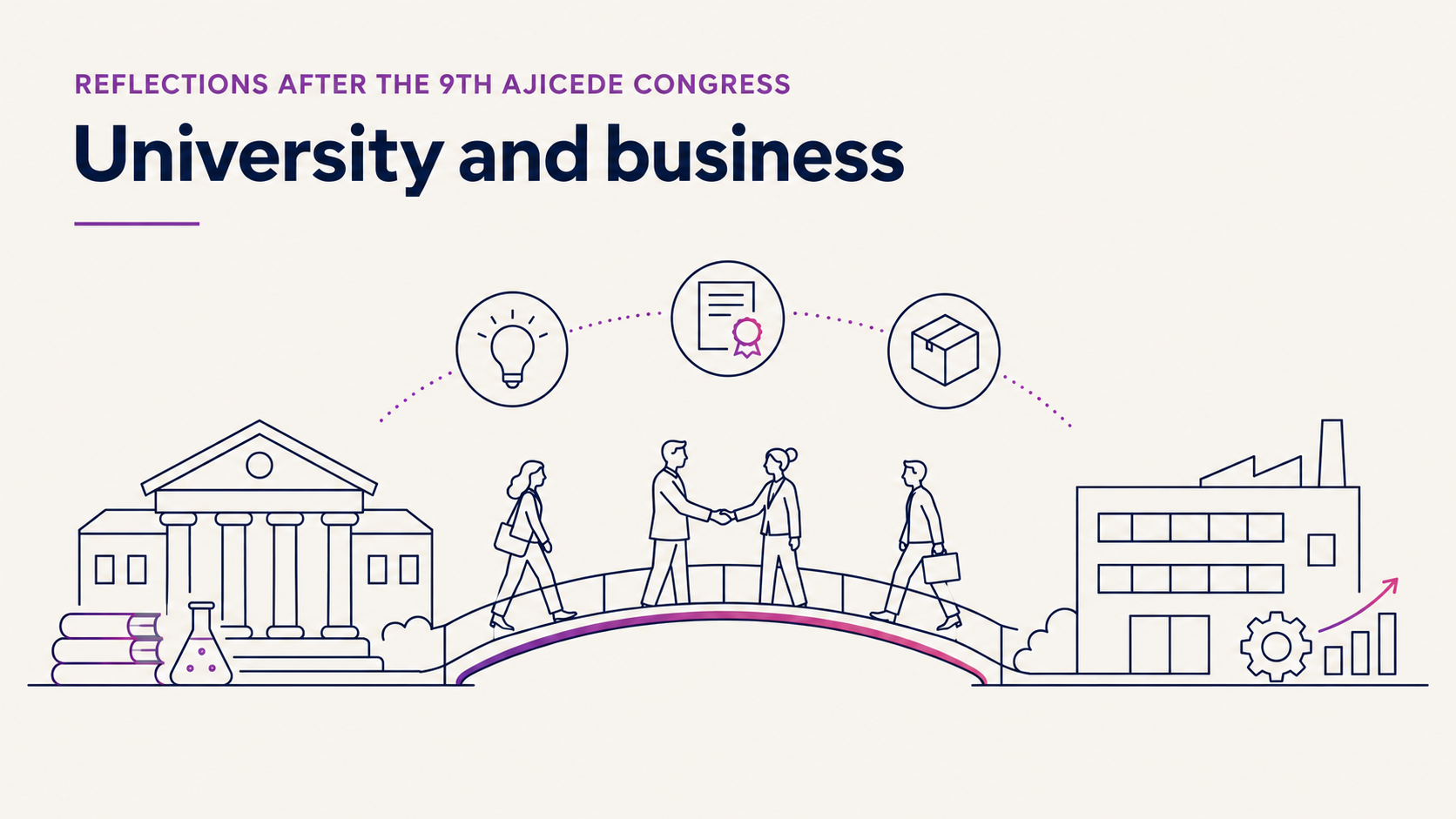
On 18 November, I took part in the opening session of the 9th AJICEDE Congress at the University of Seville, where we discussed knowledge transfer, applied research and collaboration between universities and businesses.
From 18 to 20 November, the University of Seville hosted the 9th Ibero-American Congress of Young Researchers in Economics and Business Management (AJICEDE), under the theme "From Lab to Market: Building Bridges Between Academia and Industry."
I had the pleasure of joining the opening panel, which focused on university–industry knowledge transfer and the role of university chairs, spin-offs and applied R&D.
I shared the discussion with Manuel Rey Moreno, Professor of Marketing at the University of Seville, and Manuel Terriza León, CEO of Grupo BGO. The session was moderated by Antonio Leal Rodríguez, Professor of Business Organisation at the University of Seville and CIO of Minzer.
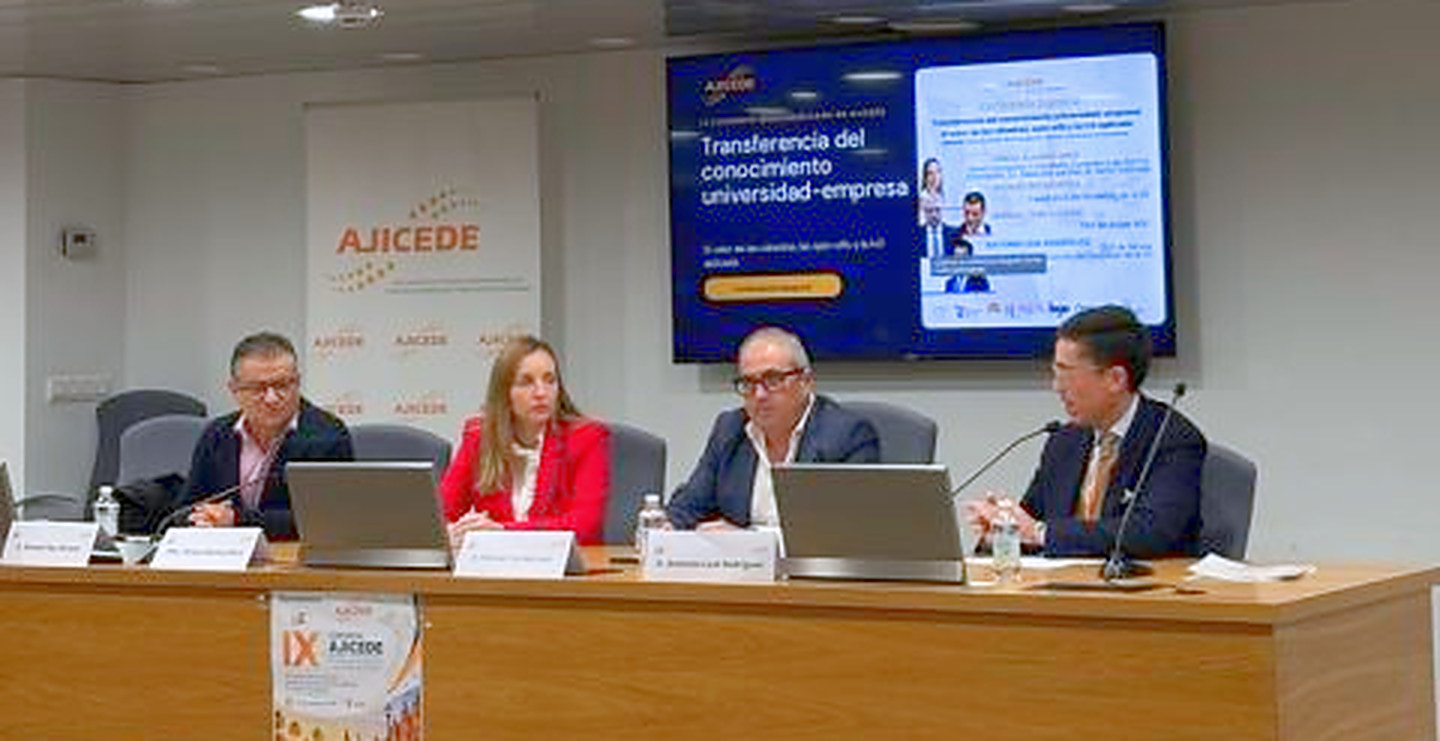
It was a great opportunity to discuss something closely connected to my everyday work: how research developed at universities and technology centres can reach businesses and find practical applications.
Video by El Impulsor: Watch the congress video on TikTok
Universities and businesses: different perspectives, shared opportunities
After years of working on the preparation and management of R&D&I projects, I have seen that universities and companies do not always have the same priorities or work to the same timelines.
Research groups aim to advance knowledge, tackle scientific questions and generate new results. Companies, meanwhile, need to develop products, improve processes or solve specific problems, often within much tighter deadlines.
These differences are understandable, and they do not have to be an obstacle.
In fact, an important part of my work is finding where those interests meet. Some companies need scientific or technological capabilities they do not have in-house, while research groups may have developed promising technologies that could find applications with the right industrial partner.
In my experience, collaboration works best when it starts early, while the project objectives and potential solutions are still being defined. This gives everyone a better understanding of what they can contribute and what they hope to achieve.
Public funding helps, but it should not be the only reason to collaborate
Funding programmes from CDTI, the Spanish State Research Agency (AEI) and Horizon Europe offer valuable opportunities for joint projects involving companies, universities and research and technology organisations.
They allow partners to share risks, bring together complementary expertise and undertake developments that many organisations would struggle to pursue on their own.
However, when building consortia, I sometimes come across partnerships formed mainly because a funding call requires certain types of organisations to participate.
Meeting the eligibility requirements is necessary, of course, but there needs to be more to the collaboration than that.
For a partnership to work, each organisation should understand what it brings to the project, what it expects to gain and how it will be able to use the results. Questions such as intellectual property ownership, exploitation rights and responsibilities for technology validation also need to be addressed from the outset.
These issues can sometimes receive less attention during proposal preparation than they deserve, only to become much more complicated once the project is underway.
Spin-offs and university chairs: different ways of bringing research closer to the market
Another topic discussed during the session was the role of university chairs and academic spin-offs.
Both can help strengthen collaboration between academia and industry, although they serve different purposes.
University chairs can support longer-term relationships between universities and businesses, helping them identify shared interests and develop joint research, training and knowledge-transfer activities.
Spin-offs, meanwhile, provide a route for bringing technologies and scientific knowledge developed within universities into the market.
From my experience working with technology-based companies, one of the main challenges for academic spin-offs is combining a strong scientific foundation with the capabilities needed to build a business.
A technology may be scientifically sound and thoroughly validated, but still need considerable work before it becomes a commercially viable product.
That requires market knowledge, management capabilities, funding, business development and, quite often, bringing new profiles into the team to complement the researchers.
Universities, companies, investors and specialised professionals can all play an important role in that process.
Bringing research closer to real-world needs
I particularly appreciated that a congress aimed at young researchers chose to dedicate its opening session to these questions.
Research has value in its own right, and not every scientific result needs to become a commercial product. But when there is potential for practical application, it is worth exploring how to move it forward.
And the relationship should work both ways: businesses can also bring challenges and needs that open up new lines of research.
That is one of the main ideas I took away from the congress: universities and companies need more opportunities to get to know each other, start collaborating earlier and make better use of their complementary strengths.
My thanks to AJICEDE and the University of Seville for the invitation, and to Antonio Leal, Manuel Rey and Manuel Terriza for sharing the discussion.
El Impulsor has published an article about the congress and the role of university–industry collaboration in connecting research with wider social and economic needs:
At Álamos Innovación, this is very much part of what I do: helping companies, universities and research and technology organisations find the right partners, shape collaborative R&D&I projects and secure public funding to bring them forward.